
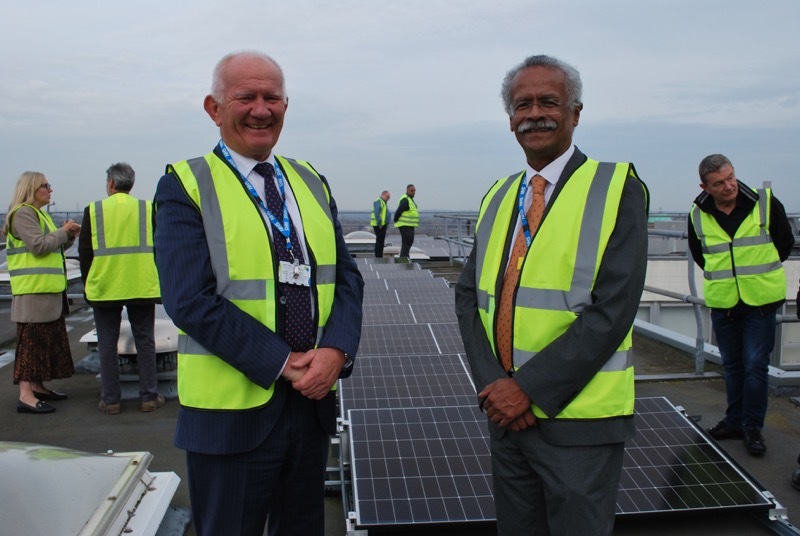

A HUGE project which set out to future-proof Barnsley Hospital’s ambitions to slash its carbon emissions has been completed - after 1,001 solar panels were switched on for the first time.
Leaders gathered on the Gawber site’s roof last Thursday to toast the achievement, which will result in an annual carbon saving of 73 tonnes.
The new solar panels are expected to save hundreds of thousands of pounds in energy costs for years to come and to free up vital funds to improve patient care and local frontline services.
According to those behind the project, the hospital’s panels have the capacity to power up to 140 homes.
Michael Wright, managing director, said: “We are proud to be part of this important solar initiative.
“Installing solar panels across our buildings will not only help reduce our energy costs while powering our buildings with clean, renewable energy, directly supporting our commitment to achieving net zero.”
NHS services have been hit with rocketing energy bills in recent years, costing taxpayers millions of pounds, and eating into healthcare budgets.
This has been driven by the UK’s dependency on global fossil fuel markets and the NHS is the single-biggest public sector energy user with an estimated annual energy bill of around £1.34bn, which has almost doubled since 2019./
As part of the hospital’s ‘Green Plan’, it has adopted a range of cutting-edge technologies, from intelligent building management systems that optimise energy use, to heat recovery and air-source heat pump installations, to electric vehicle charging infrastructure supporting greener transport.
Dan Jarvis, MP for Barnsley North, added: “This is fantastic news for our local hospital and for patients across Barnsley.
“Every pound saved by lowering the hospital’s energy bills is money that can be spent on reducing waiting lists.
“The government’s investment in clean, homegrown energy for the NHS will not only save taxpayers’ money and free up resources for frontline services, but it will also help our public services to reduce their carbon emissions.”
Head of projects Alan Heathcote said the decision to use solar panels will help generate 378,660 kilowatt hours of energy.
“This project represents more than just a new piece of technology, it symbolises our commitment to environmental stewardship and innovation within healthcare.
“By harnessing clean, renewable energy we are making a significant step towards reducing our carbon footprint and ensuring that our hospitals can continue to care for both our people and our planet, for generations to come.
“Together, these initiatives bring us closer to our goal of becoming net zero carbon by 2040.
“This solar installation is just the start - it shows what can be achieved when innovation, teamwork and vision come together.
“I’d like to thank everyone involved for supporting this project.”