

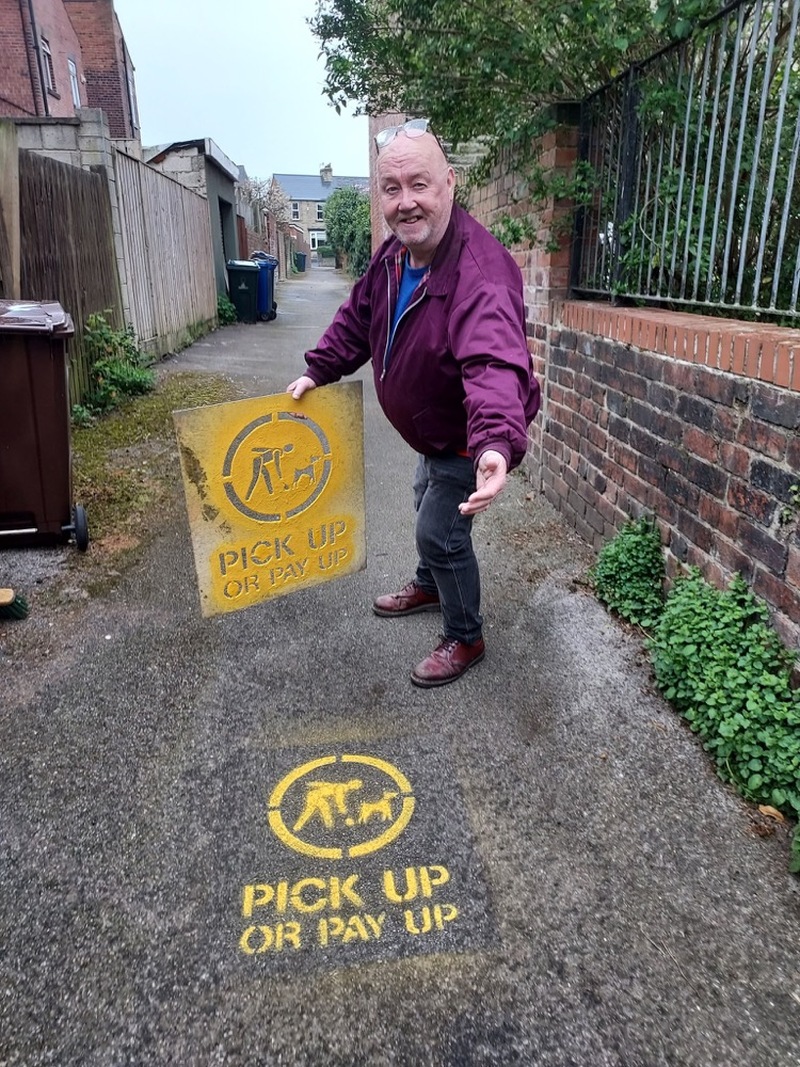
FED-UP councillors who have urged dog owners to pick up after their pets have taken matters into their own hands on worst-hit streets in Barnsley - as a last-ditch attempt to clean up the area.
Couns Steve Bullcock and Philip Wright, who represent the Kingstone ward, have taken to stencilling warnings on footpaths and alleyways impacted by dog fouling.
The main hope with such signs, they say, is to prod the conscience of the dog walkers who leave muck on the paths.
According to a Freedom of Information request, Barnsley ranked 23rd out of more than 300 councils on the national list for dog fouling, with more than 2,000 fixed-penalty notices dished out since 2018.
Fines can be issued to anyone over the age of 11 but when a fine is paid it is an admission of the offence and prosecution can be avoided.
For those who do not pay the FPN issued to them, prosecutions through court can follow and this can lead to a fine of up to £1,000 being imposed.
Coun Bullcock pleaded with owners to be responsible and help clear their local areas.
“Kingstone’s had it particularly bad for fly-tipping but dog fouling is also a serious issue,” he told the Chronicle.
“By stencilling messages on routes we’re aware have been impacted by irresponsible owners failing to pick up after their pets, we hope it will make them think twice about leaving it behind.”
Barnsley Council introduced a public space protection order (PSPO), which requires owners to keep their dogs on leads in cemeteries, pick up dog faeces, and to put their dog on a lead when requested to do so by an authorised officer.
A formal public consultation took place prior to the implementation of the PSPO which yielded over 1,000 responses, including a response from The Kennel Club.
Failure to comply with the regulations could result in a £100 on-the-spot fine, and non-payment could land the owner with a £1,000 court fine.
A council report added: “Environmental crime is a blight on local communities whether this is dog fouling, fly- tipping or littering.
“With all other offences such as littering and fly-tipping there is current, suitable legislation available for the enforcement; however, there was no legislation for dog fouling or dog control without developing a PSPO.
“Dog fouling is a significant concern to many people, not just because of the mess it causes but because it can be a health risk.
“Dogs may deposit roundworm eggs - toxocara canis - in their faeces, which become infections after about three weeks and can remain for up to two years.
“Anyone, but particularly children playing near the ground, can risk picking up and swallowing the eggs.
“The eggs can then pass into the bloodstream into the body, creating a range of symptoms related to toxocaral infection.
“Many local authorities across England and Wales have now taken advantage of the Antisocial Behaviour, Crime and Policing Act 2014 for dealing with dog related issues by introducing a borough-wide PSPO with a range of conditions.”