AN often-forgotten piece of Barnsley’s industrial past is being painstakingly revitalised by a hardy group of volunteers who are keen to safeguard its future. Josh Timlin spoke to the keen volunteers behind its restoration.
When people think about Barnsley’s proud industrial history, coal mines and glassworks are the immediate things which spring to mind as they were - after all - the two biggest occupations which dominated the borough for centuries.
However, one oft-overlooked part of that proud past is something that’s most certainly a key part of the town’s prosperity back then, and that’s its canals.
At a public meeting on October 15 in 1792 at the Royal Hotel - now known as the White Bear - in Barnsley town centre, a conflict with the Don Navigation’s waterway was resolved.
It was agreed that the Don would promote what became the Dearne and Dove Canal from Swinton to a junction with the Barnsley at Hoyle Mill and that the Barnsley Act would provide certain assurances regarding traffic to the Dearne and Dove from the Barnsley’s proposed line from Barnsley through Barugh to Barnby Basin.
The Barnsley Act was passed in June 1793; share capital was set at £80,000 with the Aire and Calder undertakers taking £20,000 to meet the estimated cost.
William Jessop was the consulting engineer and Samuel Hartley the resident engineer, supervising the day-to-day work. The company chairman was Walter Spencer-Stanhope of Cannon Hall, the owner of most of the land above Silkstone’s coal.
Barnsley Canal was approved by Parliament in 1793 and, six years later, the section between Barnsley and the Aire and Calder Navigation near Wakefield opened in 1799, with the section from Barnsley to Barnby Basin opening three years later.
It was a broad canal with 15 locks between the River Calder and the main level at Walton, just several miles from the Barnsley border.
A further five locks took the canal up to Barnby Basin, with water needing to be back-pumped up this flight as the company was not allowed to take water from the River Dearne at Barnby.
The main level was supplied from Wintersett and Cold Hiendley reservoirs but half a mile east of Barnsley, the canal crossed the River Dearne on a high, five-arch aqueduct.
On its southern-most side, this aqueduct was the junction with the Dearne and Dove Canal, which opened in 1804 and ran to the River Don at Swinton.
The colliery at Barnby ran into difficulties fairly soon after the canal opened, but the company built a tram road from Barnby Basin to Silkstone Colliery, which produced quality coal, helping the canal to be very successful.
Barnby Colliery later re-opened and other collieries close to the canal’s route through Barnsley, Monk Bretton and Royston added to its prosperity.
Sixteen miles in length and boasting 20 locks, the boats which used the waterway carried coal for two centuries until it was officially closed due to dwindling commercial use in 1953.
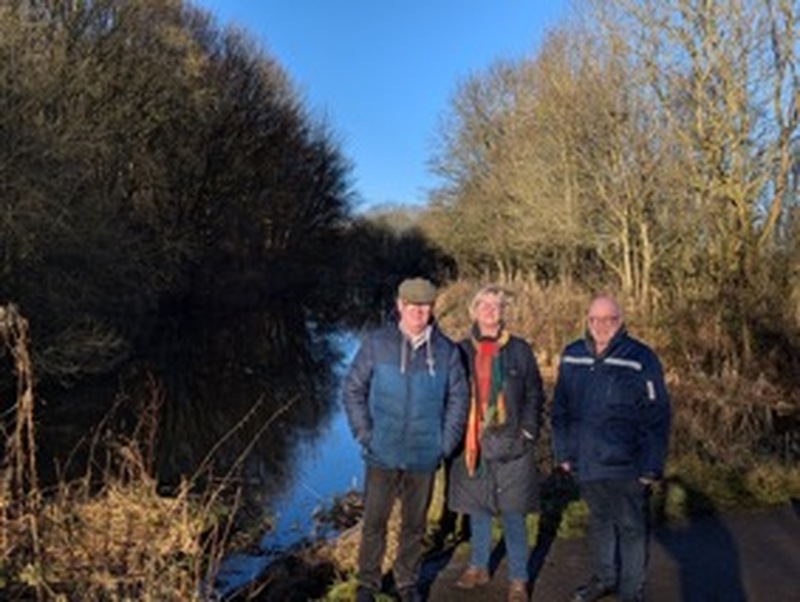
More than 70 years on, the Barnsley Canal Group’s members are doing their bit to restore its stretch on the outskirts of the town centre, in particular on Twibell Street.
The group secured ‘Pride of Place’ funding from Barnsley Council, which has supported dozens of community-led projects across the borough, including the most recent refurbishment of the so-called ‘32 Steps Bridge’ over the canal at Wilthorpe.
Volunteer Martin Exelby told the Chronicle that plans are in place to completely clear the lock in order to see its almost three-centuries-old workings.
“The long-term plan is to make it a real heritage hub for schoolchildren to visit - Barnsley’s not just known for its coal and it’s more about glassworks and linen, too,” he said.
“Every part of Barnsley’s past industries went through the canal as it was an integral way of getting materials to and from Wakefield during the 1800s and 1900s.
“Barnsley Council and the Central ward’s councillors have offered so much support and the Pride of Place funding has been invaluable to us.
“A lot of work has been done and that’ll continue - we’re a small group but we’re dedicated to preserving the site.
“There’s the old ruins of the lock keeper’s cottage and its history is extremely important to Barnsley.
“Many places are dry, as is the lock in which we’re responsible for, but if we can all do our respective bits, it will all help towards that as we’ve seen elsewhere.
“There’s so much potential along its route and the chance to improve wildlife habitats throughout its course.”
On December 7, 1950 the last boat passed Royston Bridge. On June 10, 1952 the last boat used Heath Lock.
“We’ve a Facebook page - Barnsley Canal Group - and we’re always on the lookout for people to help,” Martin added.
“Ideally I’d love to see Barnsley Canal completely restored to as it was with water throughout its sections, but in many sections that’s just not currently feasible.
“However, it is exciting to see its progress and what’s being done at other disused sections of canals elsewhere.”