BARNSLEY’S ‘most dangerous’ stretch of road - which has claimed innumerable lives in a decade and has appeared on the country’s list of fatal hotspots - will not receive further remedial work despite campaigners’ efforts to secure a ‘vital’ speed limit reduction.
The A616 Whams Road - specifically Hazlehead’s crossroads - has claimed two lives in the last five years but three serious pile-ups in October 2023 before two more in April and May last year reignited a campaign to prevent lives being lost.
Despite campaigners’ calls for a speed limit reduction on the road from 60mph to 40mph - backed by councillors and ex-MP Miriam Cates - concerned locals say little has happened to reduce drivers’ speed or improve safety since.
The Chronicle understands the last time an in-depth study was carried out was in 2009 through what was then known as the South Yorkshire Local Transport Plan Partnership.
So-called ‘worst-first’ roads were named - including the crossroads - and it was concluded that the percentage of killed and serious collisions on the route stood at 45 per cent, which was ‘statistically significant’.
Road safety bosses - including from the council, South Yorkshire Police and the South Yorkshire Mayoral Combined Authority (SYMCA) - have all been accused of denying nearby residents’ attempts to discuss the goings-on.
However, it’s now been revealed by the police that no formal approach has been made to reduce the road’s speed - which campaigners claim is a key part of its excessive collisions.
A South Yorkshire Police spokesperson said: “We have never been formally approached by Barnsley Metropolitan Borough Council with any proposal to reduce the speed limit.
“If a formal request is made, then we would consider the application.
“We have never formally objected to a reduction of the speed limit.
“That, having been said, it is likely that if such a proposal were made, we would look to the highway authority to explore significant engineering measures as required to secure general compliance.
“In order to achieve general compliance with a 40mph limit on this section of road there would need to be extensive engineering measures introduced.
“Speed data showed prevailing speeds well above 40mph, so simply changing the speed limit signs to a lower one would have little impact.
“Were the highway authority to support a lower limit with such measures as mentioned - traffic calming - then the target speed may be more achievable.
“However this isn’t something they would be likely to consider on a road of this nature.
“From a road safety perspective, imposing an artificially low limit on any road and simply hoping for compliance is not the correct or safe way to influence vehicle speeds.
“Any speed limit should be either self-enforcing or made such through appropriate engineering measures.
“In the event of the highway authority reconsidering this location for treatment, we will be part of the discussions.”
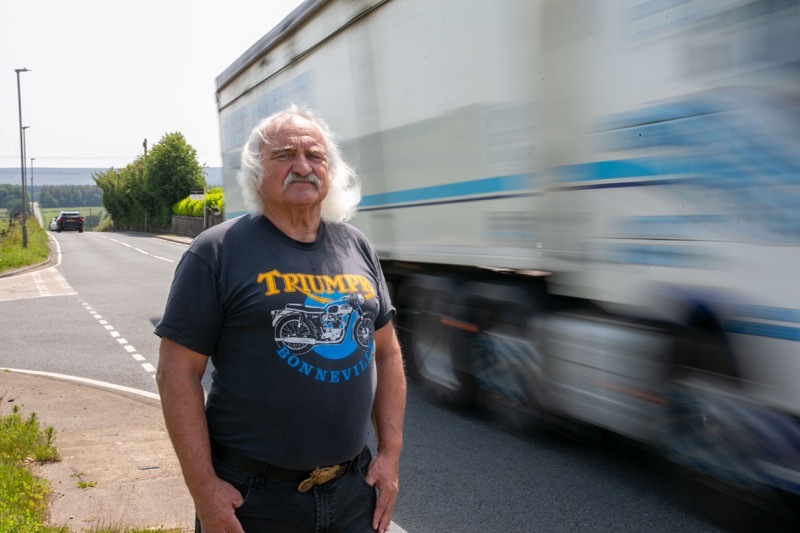
Campaigner Mick Drewry, from nearby Dunford Bridge, told the Chronicle it was the town’s most dangerous stretch.
“I’ve contacted both the council and the police who seem to have conflicting stories as to who is responsible for any would-be speed limit change.
“The last study’s findings suggested that statistically you are nearly three times more likely to be killed or seriously injured in a collision along this route.
“Since 2009, there have been six more fatalities and at least one life-changing injury collisions on this route.
“They are collectively failing to address the issue.
“There’s been a continued failure from the council’s highways department and politicians to address the number of serious collisions on this stretch of road.”
The council - in recent years - spent £50,000 on the road which saw lighter-coloured surfacing, ‘slow’ signs on the approaches and ‘dragon teeth-style’ road markings - all of which were commissioned to alert drivers to the oncoming danger of the crossroads.
Coun Hannah Kitching, leader of the Liberal Democrats in Barnsley, told the Chronicle that the 60mph limit is too high.
“It’s a 60mph limit and that’s too much - logic suggests anyone involved in a crash has a better chance of surviving if it happens at 30mph or 40mph.
“People have died and it’s time for a serious response from both the police and the council.
“The issues the road has is a constant source of complaints from those who use it and those who live nearby.”