Analysis of Barnsley's 2-0 loss at home to Lincoln City in the EFL Trophy on Tuesday.
LOWEST RECORDED CROWD WATCHES TROPHY LOSS
THE LOWEST crowd in Barnsley’s recorded history for a first team game saw them lose their final group fixture of the EFL Trophy at home to Lincoln.
The official attendance was 1,202 with 161 away fans, more than 300 down on the previous trophy game against Manchester United under 21s. There were more people at last season’s NCEL play-off final between Wombwell Town and Dearne and District in the tenth tier.
There was little appetite to watch what was almost a dead rubber, which was also on TV, in a much-maligned competition on a very wet night at a ground where, despite an impressive first few games of this season, there has not been much to cheer in recent seasons.
There have been several cup games at Oakwell this autumn in front of tiny home crowds with one stand open, and very few home league matches. They need the bigger, more meaningful games with a larger and more vocal crowd to feed off to help kick-start this strange, stop-start season.
Ultimately Barnsley won their most important game of the week, a crucial victory at Doncaster on Saturday which ended a winless league run. The majority of fans would surely have been reasonably happy with the outcome of the week on Friday.
But this defeat was a reminder there is still plenty of work to do ahead of a tough-looking series of league matches when they face Luton, Stockport then Lincoln again four weeks after this game.
They now have what is left of the international break to keep working to improve a worryingly bad defensive record and figure out how to create chances against teams who sit back and counter-attack. They should have some key players back from international duty and injury as they enter a crucial run up to Christmas.
THROUGH DESPITE TWO GROUP LOSSES
Despite the defeat, Barnsley reached the knock-out stages of the EFL Trophy – finishing on three points but with a better goal difference than both Notts County and Manchester United under 21s.
The Reds went into the game knowing they would qualify for the knock-out rounds if they did not lose by seven goals and would win the group if they won by two. If Lincoln had taken all their chances, the seven-goal defeat might have looked borderline realistic at one point, while the Reds never appeared likely to win after going behind.
It is strange that Barnsley have made it through a group despite losing two out of three games and only beating an extremely young United side who gave them scare but had a player sent off. They have conceded twice in each of their games and finished six points behind the Imps who took maximum points and did not concede a goal.
The Reds made five changes from the league win at Doncaster. That was partly due to international call-ups but also a desire to only use first team players and academy players who the coaches feel have earned the gametime. There were only six on the bench, with seven allowed.
Conor Hourihane has taken the competition much more seriously than some of his predecessors, selecting relatively strong sides throughout. He knows what it feels like to win the trophy but, more importantly at this stage, how it can aid a league season and create momentum if you go on a cup run. But they will have to play much, much better than they did on Tuesday to have any chance of progressing beyond the last 32.
BRIGHT START THEN SECOND BEST
For just under 20 minutes, Barnsley played very well.
As they dominated the ball, knocked it around attractively and created a series of half-chances, it felt as though the momentum from the excellent result at Doncaster at the weekend would continue into the international break.
But suddenly Lincoln woke up, started competing much better for every ball and attacking the Reds. They created regular chances, taking two of them, and were easily the better side from about the 20-minute mark on a pitch that would become increasingly saturated by the constant rain. Lincoln are in League One’s top six, four points clear of the Reds, but were winless in four in all competitions and had lost 3-0 at Rotherham on Saturday – from which they made nine changes at Oakwell.
Defending deep, being aggressive in duels and a threat on the counter is a sound template of how to beat this Barnsley team. They have lost three of their last five at home, scoring in none of those three, with the league defeats to Port Vale and Rotherham similar to this game.
The Reds may hope that their next visitors Luton are more attacking and expansive which might suit them better, but the Hatters also arguably have more proven quality than the three teams who have just won at Oakwell.
TWO LONG PASSES OPEN REDS UP FOR GOALS
Tendayi Darikwa has had a solid career as a full-back in the EFL but is not particularly known for opening teams up with piercing passes.
But the Lincoln captain did so to Barnsley for both goals in this game, each time passing from within his own half and putting two totally unmarked team-mates clean through behind a struggling defence.
For the first goal, Barnsley’s defensive line was on the halfway line and had been dragged way over to the left, with Jack Shepherd challenging for a ball on the touchline then right centre-back Jake Rooney almost in the left-back position when he inexplicably let Darikwa’s pass go straight through him. That put two Lincoln players clean through and Erik Ring squared for Francis Okoronkwo to tap in.
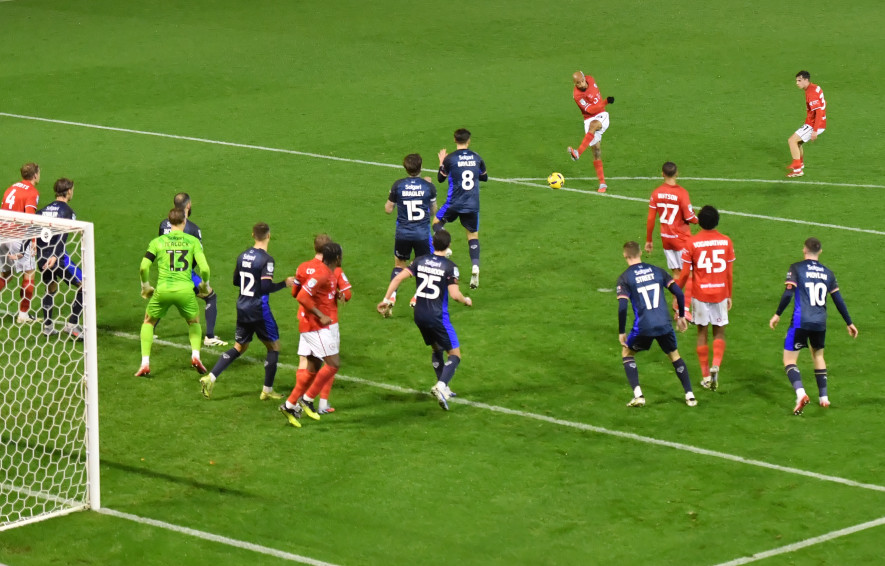
For the second goal, Lincoln had their centre-backs up following a set piece and ex-Red Adam Jackson beat a disorganised offside trap to run onto Darikwa’s long pass and head into the path of James Collins who brilliantly controlled it then volleyed into the bottom right corner. There were Lincoln players in offside positions when the ball was played but Jackson was not one of them as he easily got away from Tennai Watson and Rooney.
Collins, a former Ireland and Derby team-mate of Conor Hourihane, has nine goals in 13 games against the Reds.
It has been a tough week for Rooney. While he was out of position at left-back against a flying winger on Saturday, this time he was in his natural role but looked cumbersome, slow and static – letting the game happen to him instead of having any positive impact on it. He almost put Collins clean through on goal after passing the ball into his standing foot.
He was not the only player who underperformed – there was loosing passing, lacklustre tackling and poor marking throughout the team.
Barnsley are often very easy for most third tier sides to create chances against and, unless they tighten up significantly, they will concede far too many goals to challenge for promotion, and take some real pastings along the way off more clinical teams.
There are too many individual errors and, even more worryingly, regularly a collective looseness and lack of cohesion from front to back when defending.
MOST PLAYERS UNDERPERFORM
There are not too many Reds players to highlight for particularly positive performances.
Kieren Flavell was solid in goal as he has been throughout his competition, keeping the score down with decent saves, while Shepherd was again the best defender, brilliantly clearing off the line at 0-0.
Full-backs Watson and Nathanael Ogbeta were not at their best defensive or in attack. Luca Connell played some good passes but also a terrible one which should have resulted in a goal, then came off with illness and was replaced by Luke Alker – one of two teenage academy substitutes along with Kieran Graham. With Barnsley’s midfield options severely depleted by injuries and international duty, Vimal Yoganathan played alongside Connell in a deeper role than the one he thrived in on Saturday – battling hard but struggling to make an attacking impact.
Caylan Vickers – who was an unused substitute in the previous two games having been ever-present for months before losing form – played on the left wing but did little to push for a league recall.
Neil Farrugia was much more eye-catching tucking in from the right wing – mainly early on when he was instrumental in the Reds’ good start – and finished the match as a right-back following substitutions and also captain after Connell went off.
David McGoldrick started in the number ten role behind striker Davis Keillor-Dunn, and they were both quiet after a few good moments early on. McGoldrick had a few long-range shots but none came close. Reyes Cleary came off the bench and at least added some impetus, creating a couple of openings.