
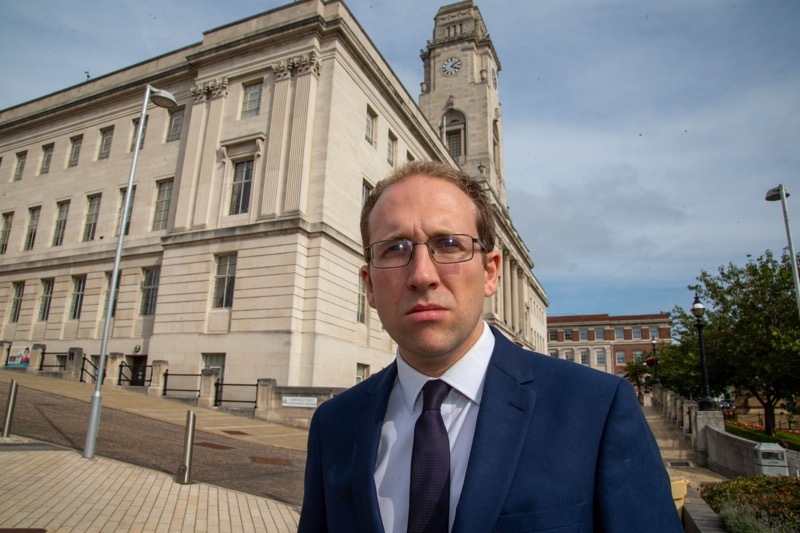
A BARNSLEY councillor has issued a powerful plea to families to get their children vaccinated - warning of a return to the ‘dark days’ when preventable diseases claimed the lives of thousands of local children.
Coun Alex Burnett, who is a doctor, spoke of the story of Alfred Guest who died from smallpox in Kendray Hospital in 1892.
Since the Covid-19 pandemic, uptake of childhood and adult vaccines has fallen both nationally and locally.
Measles cases have surged, with more than 500 reported across England this year and a child in Liverpool becoming the first to die from the disease in over a decade.
“At the turn of the 20th century, nearly one in every four children born in Barnsley died,” Dr Burnett said.
“Two of the leading causes were smallpox and measles.
“The thought of a child dying is one that sends chills into the heart of every parent.”
He paid tribute to Lady Mary Wortley Montagu, a public health pioneer from his own ward of Penistone East, who helped introduce inoculation to Britain and vaccinated her own children against smallpox.
Smallpox had first appeared in Europe in the early medieval period and over time became more deadly, causing an estimated 60 million deaths between 1700 and 1800.
Whilst living in Turkey, Lady Mary - who was born in 1689 - observed the local method of inoculating against smallpox, which involved scratching the skin and introducing a small amount of the virus taken from the pus of someone with a mild form of the disease.
This, in turn, then provoked a mild form of smallpox, leaving lasting immunity and the medical breakthrough - which she promoted widely, often being met with denunciation - was the first time in western medicine that antibodies were created to secure immunity from disease.
The disease had killed several of Lady Mary’s own relatives, including her brother, and she herself had nearly died of it.
After looking into the practice with Charles Maitland, surgeon to the British embassy in Constantinople, she organised for the procedure to be carried out on her five-year-old son by a skilled local woman.
Although she was not the first European to have a child inoculated while living in Turkey, she was the first to bring the practice home.
“It’s a triumph of human society that we’ve collectively overcome such terrible diseases,” Dr Burnett added.
“That’s why it fills me with sadness to read that there’s been a decline locally in the uptake of routine vaccinations.”
In Barnsley, the council’s public health team is responding with targeted work, including a small-but-impactful pilot called the Barnsley Vaccine Equity Project.
Presented to the health and wellbeing board in May, the £5,000 scheme aims to understand and address vaccine hesitancy, particularly among eastern European migrant communities, where uptake has been notably low.
Dr Burnett welcomed the project, but stressed that barriers to vaccination go beyond cultural hesitancy, and also condemned the rise in vaccine misinformation and conspiracy theories, warning that scientific progress is under threat from political populism.
“This is not a problem solely confined to any one ethnic group,” he said.
“Not being able to get time off work and not being able to afford transport costs to GPs also are barriers to vaccination that need addressing.”
“We support our public health department in vaccinating our children against these terrible illnesses, and condemn those who spread lies and division in our society.
“To all those in Barnsley that are unsure about whether to get themselves or their children vaccinated, I want to urge you, in memory of Alfred, who died in Kendray Hospital of smallpox over 100 years ago.
“Also in memory of the thousands of Barnsley children who died of preventable infectious diseases before the advent of vaccines, and in the name of those around the world who don’t have the privilege of being able to access these safe, life-saving vaccines, please, please get you and your children vaccinated.”