

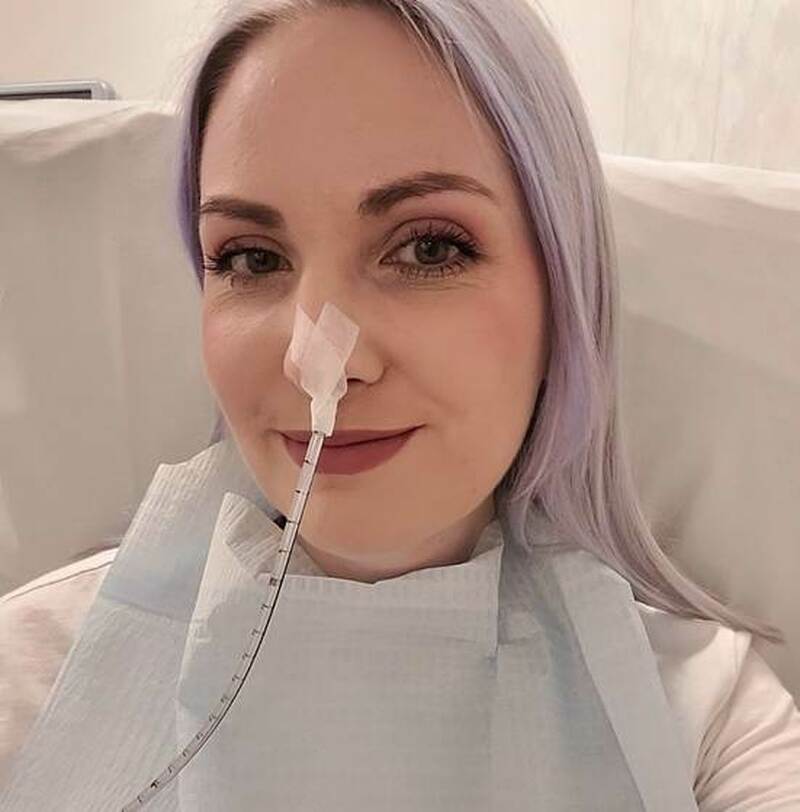
A BARNSLEY woman is using her experience of living with a rare oesophageal condition to raise awareness and champion the work of a national charity.
Leanne Sim has lived with achalasia - which affects one in 100,000 people - and limits food and drink from moving down the oesophagus into the stomach, making eating and drinking difficult.
To mark the week, and to coincide with Achalasia Awareness Month, charity Guts UK is shining a spotlight on Leanne, a 35-year-old mum of three from Barnsley who lives with end-stage achalasia.
As the only UK charity funding research into the entire digestive system, Guts UK is committed to amplifying the voices of those with digestive conditions.
Leanne, 35, said: “There isn’t a cure for achalasia yet and probably won’t be in my lifetime.
“For me, nothing has fixed it - every time there’s hope, there’s then disappointment when my symptoms return so it’s exhausting both physically and emotionally.
“I hope that with the support of gifts in wills pledged to Guts UK, research can be funded into finding kinder treatments to help those with achalasia and other digestive conditions in generations to come.”
Leanne’s symptoms began when she was just eight years old.
By nine, she was struggling to swallow even a few bites of food, often running to the toilet to bring meals back up.
After investigations, Leanne was diagnosed with achalasia aged just ten and shortly after required invasive surgery.
She added: “I was rushed in for a Heller myotomy - a surgical procedure that cuts the lining of the oesophagus and stomach - because I was so malnourished.
“I could’ve died as the food stuck in my oesophagus had started to rot.”
For years, Leanne underwent procedure after procedure to try and keep her oesophagus working, but the symptoms always returned.
In 2022, Leanne’s health drastically declined and she was admitted to hospital as an emergency.
“For a while I could eat more freely and that gave me back some normality. But achalasia always comes back.
“I couldn’t swallow anything, not even water.
“I went seven days without eating or drinking - in hospital they tried to put in a feeding tube, but my body rejected it.
“I couldn’t care for my kids - I thought about giving up as if I died, I died.
“I didn’t want my kids to see me suffer.”
Following her hospital admission, Leanne underwent POEM surgery (peroral endoscopic myotomy), which is where a camera is passed through the mouth and instruments are used to cut the muscles in the oesophagus, which helps food and drink pass through more easily, reducing the symptoms of achalasia.
Talking about her recovery from surgery, Leanne said: “I was meant to stay one night, but I ended up in hospital for nearly a week.
“The pain was awful, and the spasms afterwards were severe - it took me a couple of months before I felt even a little better.
“After the surgery, I had a jacket potato for the first time in years.
“That might sound small, but it felt amazing.
“I cried with relief but in the back of my mind, I was terrified it wouldn’t last.”
Leanne has had no further treatment since her surgery in 2022 and today is living with end-stage achalasia.
End-stage means Leanne’s oesophagus no longer functions properly, and there are very few treatment options left
“My oesophagus is exhausted but if I’d been diagnosed later in life, maybe I could’ve kept it working.
“After more than 25 years, it’s taken its toll.
“My new consultant has mentioned an oesophagectomy - removing the oesophagus completely - but it’s such a high-risk surgery, and the recovery would take a year.
“I am tired of living with this condition.
“It’s relentless as I don’t know what it feels like to swallow normally.
“Sometimes I try solid food with painkillers, but it’s so painful, and I’m scared of my oesophagus perforating.
“I’ve choked before, I’ve aspirated food into my lungs, and it made me really poorly.
“Every meal is a risk.( “When I’ve been in hospital, Guts UK have always been there for me.
“Once, when I was really unwell, they sent me a t-shirt and a few thoughtful things.
“It might sound small, but at that moment, it reminded me I wasn’t alone.
“They’ve given me a safe space to talk openly, to cry if I need to, and to know I’m understood.
“That support has meant everything.”