
A LOCAL MP who spearheaded a campaign to put more money in ex-miners’ pockets following years of ‘injustice’ heard about the impact it’s had on their lives.
Stephanie Peacock, whose Barnsley South constituency is home to thousands of former pit workers, helped champion the cause of locals in Grimethorpe, Brierley, Wombwell and Shafton where many live.
Following years of campaigning, Labour delivered justice on the Mineworkers’ Pension Scheme (MPS) last year by returning the £1bn investment reserve fund to members.
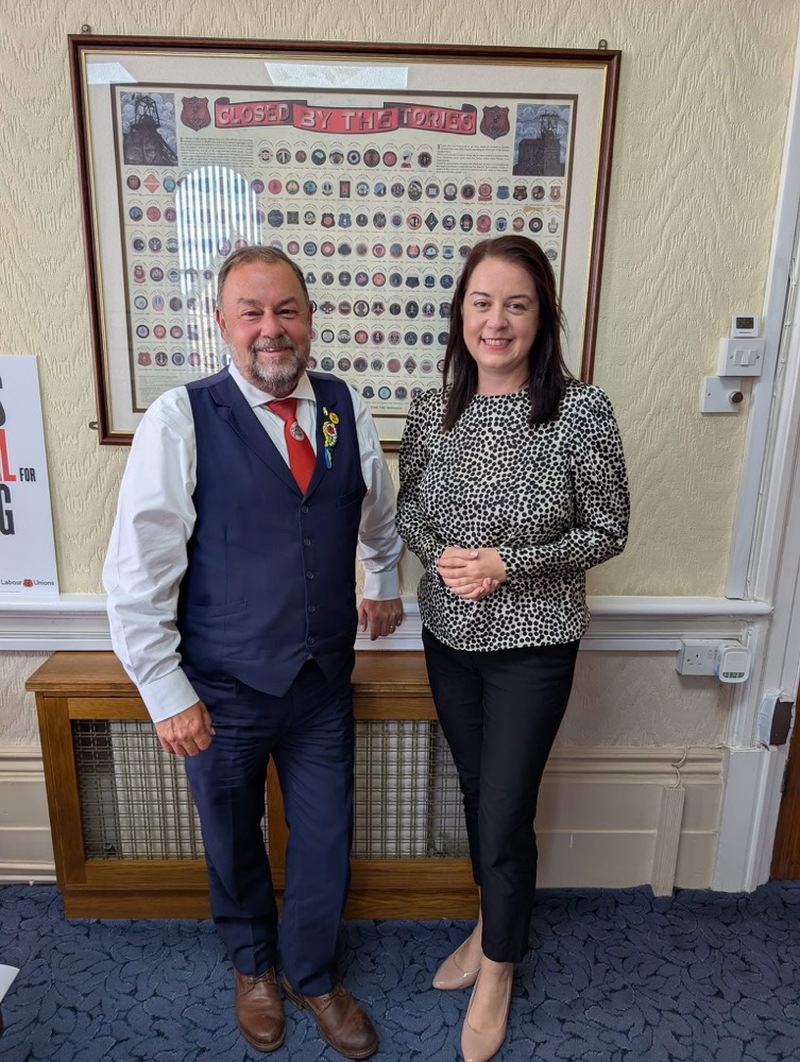
Eligible ex-miners received an immediate uplift to their pensions with increased payments worth an average of £29 a week - and Ms Peacock met with Chris Kitchen, the general secretary of the National Union of Mineworkers (NUM) to discuss its impact.
She said: “It was good to visit the NUM to meet with Chris to talk about everything from miners’ health to miners’ pensions.
“This Labour government delivered justice for the Mineworkers Pension scheme.
“More than 3,000 in Barnsley have seen an average £29 increase per week in their pension.
“I am delighted that after years of campaigning this Labour government has delivered justice for miners’ pensions.
“The delivery of our manifesto commitment means miners saw an increase in their pension and a long overdue end to the scandal which saw the previous government profiting.
“Thousands of miners and their families are better off in Barnsley as a result of this change.”
First introduced in 1952, the MPS was created for local miners to ensure they received a good pension after years of working in the coal mines and up until April 1975 members paid a flat-rate contribution of up to 20p per week.
However, following the privatisation of British Coal at the end of 1994, the then-Conservative government took over the role as guarantor for the MPS, with arrangements made whereby the government would take half of all profits in exchange for a guarantee that members would retain their benefits and in future would see them rise annually in line with inflation.
By July 2024, the government received £4.8bn from the MPS and £3.1bn from a parallel scheme, the (British Coal Staff Superannuation Scheme) BCSSS.
When the government privatised British Coal in 1994, both the MPS and BCSSS had surpluses, meaning they had more assets than they expected to need to pay the schemes’ pensions.
Chris added: “It means people have a little bit more money, which is always helpful - especially at times when money’s tight.
“But more than that it’s a recognition that the way that the government guarantee was done was to victimise us.
“It was a spiteful act to close the scheme down and ringfence money for themselves.
“We’re happy the Labour government made good on its promise.”